
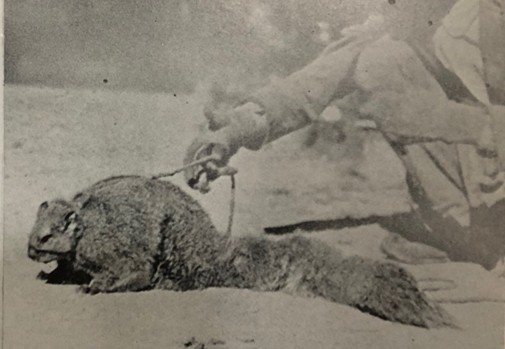
In my last blog on flying squirrels, I mentioned the King Kong of flying squirrels, the woolly flying squirrel. I wrote that this squirrel was a near-complete mystery to Western science for over a century, when it was first discovered and named from a series of about 11 skins collected from in and around the country of Pakistan in the late 1800s. The squirrel was estimated to be about four feet in length from nose to tail tip, and it had a bizarre tooth dentition, leading to wild guesses about what they ate – but nobody knew. In fact, the tooth structure was so strange that in the 1950s two French taxonomists, looking at the museum specimens, embarrassingly and incorrectly decided it was not a squirrel at all! A single photograph of a live, captive woolly flying squirrel was taken by a British Colonel in Pakistan in 1924 (it looked to be about the size of a large raccoon, with a long, fluffy, fox-like tail) – and then the squirrel just flat-out disappeared. Missing for 70 years, many people thought it was extinct, until some character (spoiler alert: me!) “rediscovered” it in 1994 in a valley high up in the mountains of northern Pakistan
It turns out that there were three reasons it was MIA for 70 years. The first was that it lived in a Tribal Area of Pakistan that was thought to be dangerous for outsiders, so nobody ever went looking for it there until I (perhaps foolishly, but successfully) did. The second was that it seems to eat mostly pine needles, a bizarre diet but one that meant that it could not be lured into traps set with the “usual” array of squirrel foods such as fruits or nuts. That diet also explains the strange tooth structure, however; and if you can evolve to digest needles, there’s a super-abundance of food available with few competitors!
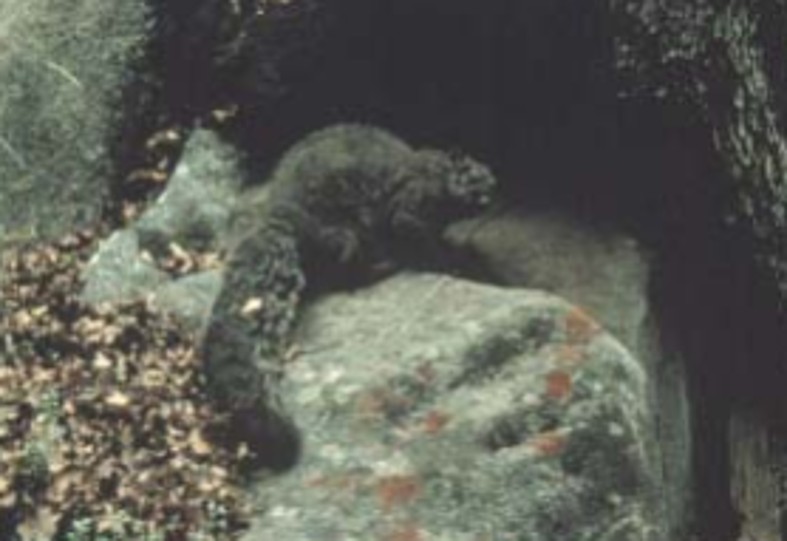
Finally, because the squirrel was so enormous, it wasn’t going to find many tree holes to live in, so it spends its days (all flying squirrels are nocturnal, coming out only after dark) hiding in caves high up on steep cliff faces – safe from both local people and prying scientists.
So how did I find the squirrels? Good question. I spent two field seasons wandering the high mountains with big live traps, baiting them with the usual squirrel food items, and catching lots of other things, like baby red foxes and stone martens and so on – but no squirrels. Then, in a check-in at a local police station, I told them what I was doing (to their utter disbelief, not surprisingly), and they mentioned that they thought that there were local people who climbed up – or rappelled down – to caves and collected a material there that could be from the squirrel, and processed and sold it for medicinal purposes (including as an aphrodisiac!).
I filed this away as a great fabrication, along with many others I’d heard in my wandering (they hang upside down like bats, they milk goats in the high pastures, and so on). But lo and behold, as I got deeper into this valley and mentioned the story, local people said yes, this material, called salajit, was in fact a real thing.
And then one day a big, bearded fellow with a gun came into my camp and said he was a salajit collector, and that he heard we were looking for chargai (the local name for the woolly flying squirrel, which interestingly meant “rock butter” in the local Shina language…). I said yes; and he said give me that potato bag and I’ll bring you a squirrel for $40. He was the one with a gun so I said sure, he took the bag, and six hours later he came back with a live woolly flying squirrel in the bag!
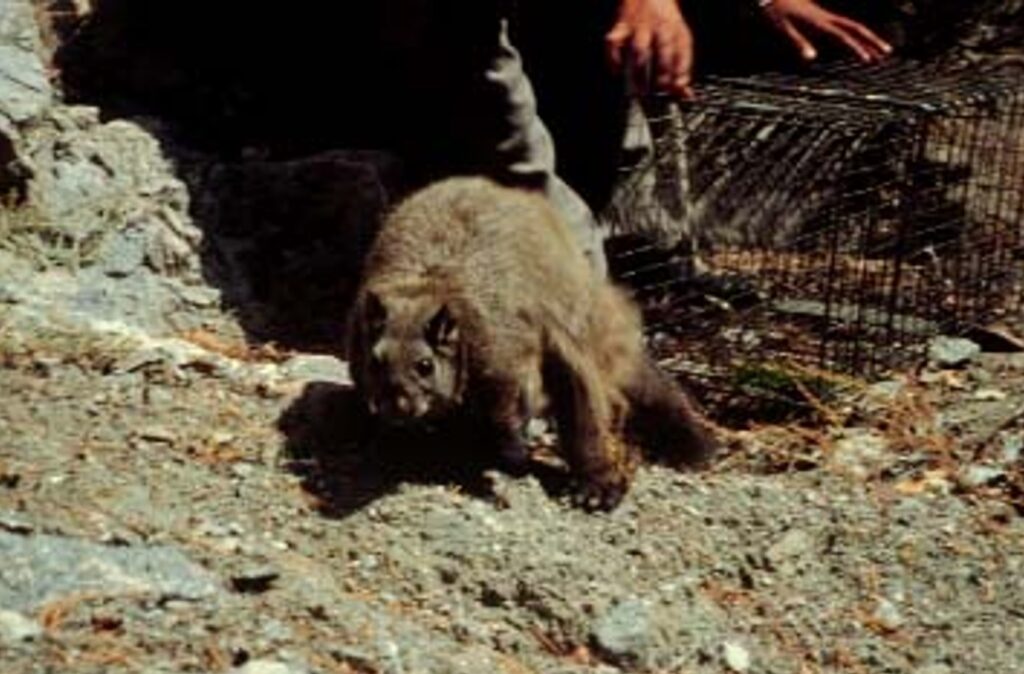
And that is, in fact, how to find the woolly flying squirrel – just find the salajit collectors! It turns out that salajit is almost certainly an indurated matrix of woolly flying squirrel feces and urine, similar to what you find in caves in the southwestern US, in those cases produced by woodrats, in hardened lumps that scientists call “middens.”
One of the things I noticed during my surveys and then research on the woolly flying squirrel was that the conifer forests in this region were rapidly being clear-cut by outside interests. This was bad for the squirrel, as well as for a host of other species, and for the local people who lived there who depend on the forests for timber, firewood, pine nuts, and even understory medicinal plants. So rather than document the actual extinction of the woolly flying squirrel, I turned around and started a community-led conservation program to protect the forests, the squirrel, and other wildlife in the region.
The program was actually wildly successful, helping to create roughly 65 new community institutions with bylaws to protect forests and wildlife, and also over 20 multi-community conservancies that functioned as small, community-managed protected areas. Unfortunately the funding for this work ended in 2019.
However, just this year, Zoo New England has found new support to re-start the program in Pakistan! Read our blog detailing this program here: