

Not a lot of people are familiar with flying squirrels. That’s because around New England they are not only quite small, but also they are only out and about in the dark of the night. They’re also super-quick, so the odds are that you’ll only see a quick blur crossing a flashlight beam.
Flying squirrels don’t fly, of course. They glide, like a paper airplane, usually from one tree to another. They have flaps of skin called a patagium stretching between their forelimbs and back limbs on either side of their body, that enables them to cross up to 100 feet or more of open space from one tree to another. See this video taken right on the Franklin Park Zoo grounds!
There are two species of flying squirrels in Massachusetts, the southern flying squirrel and the northern flying squirrel. They are essentially indistinguishable from each other. Both species are very small even for a squirrel, really no bigger than a chipmunk. They are the same shape and soft gray color, and they both are expert climbers and live in tree holes, usually old woodpecker holes. But they have some real differences. For one, as their names imply, the southern flying squirrel lives from Florida up into southern Canada, and it likes deciduous forests. The northern flying squirrel lives from around the New England region up into the far north of Canada and Alaska, right up to the tree line, and it likes conifer forests. The New England region is one of the few places where they overlap and where you can find both species.
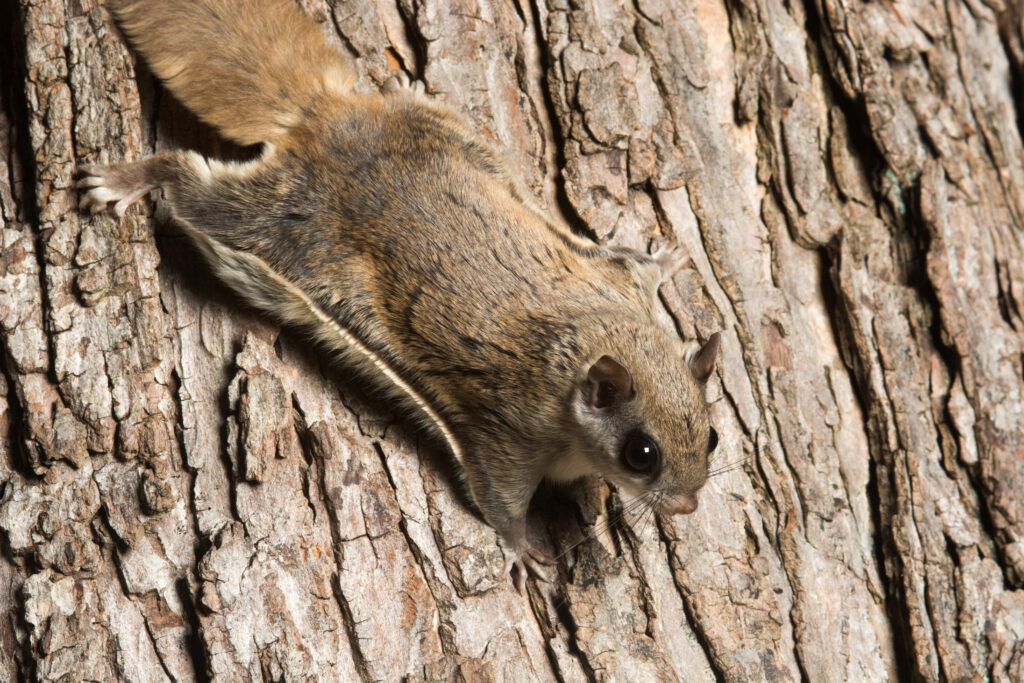
The northern and southern flying squirrels also differ in terms of their favorite food. The southern flying squirrel eats the “usual” squirrel food – nuts and seeds and berries along with catkins and young leaves. The northern flying squirrel will eat all of that (with a focus on conifer seeds due to the different kinds of forests up north), but it really likes fungus! In fact the squirrel focuses on a suite of fungus species that live on the roots of conifers and are crucial for the health of the trees (the fungi provides crucial nutrients to the trees such as nitrogen and phosphorus). But rather than the squirrels hurting the trees, their feeding actually helps spread fungal spores and encourages the growth of new fungi – a win-win(-win) relationship.
The northern and southern flying squirrels are not the only species of flying squirrel out there, however, although they are the only ones found in North America. Elsewhere, and especially in Asia, you can find over 45 other species. They come in a whirlwind of colors and patterns and sizes, from tiny ones even smaller than ours to ones aptly named giant flying squirrels, that are over three feet in length.
Finally, there is the King Kong of flying squirrels, the woolly flying squirrel. This squirrel was a near-complete mystery to Western science for over a century, when it was first discovered and named from a series of about 11 skins collected from in and around the country of Pakistan in the late 1800s. The squirrel was estimated to be about four feet in length from nose to tail tip, and it had a bizarre tooth dentition, leading to wild guesses about what they ate – but nobody knew.
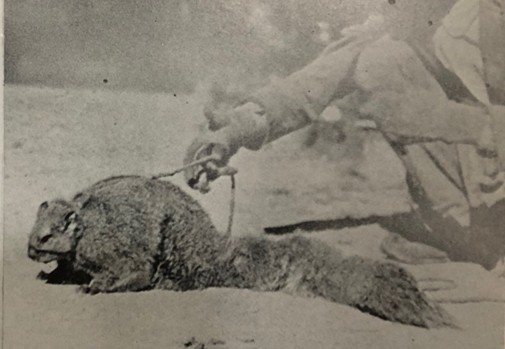
A single photograph of a live, captive woolly flying squirrel was taken by a British Colonel in Pakistan in 1924 (it looked to be about the size of a large raccoon, with a long, fluffy, fox-like tail), and then the squirrel just flat-out disappeared. Missing for 70 years, many people thought it was extinct, until some character (spoiler alert: me!) “rediscovered” it in 1994 in a valley high up in the mountains of northern Pakistan. Read about that discovery here: