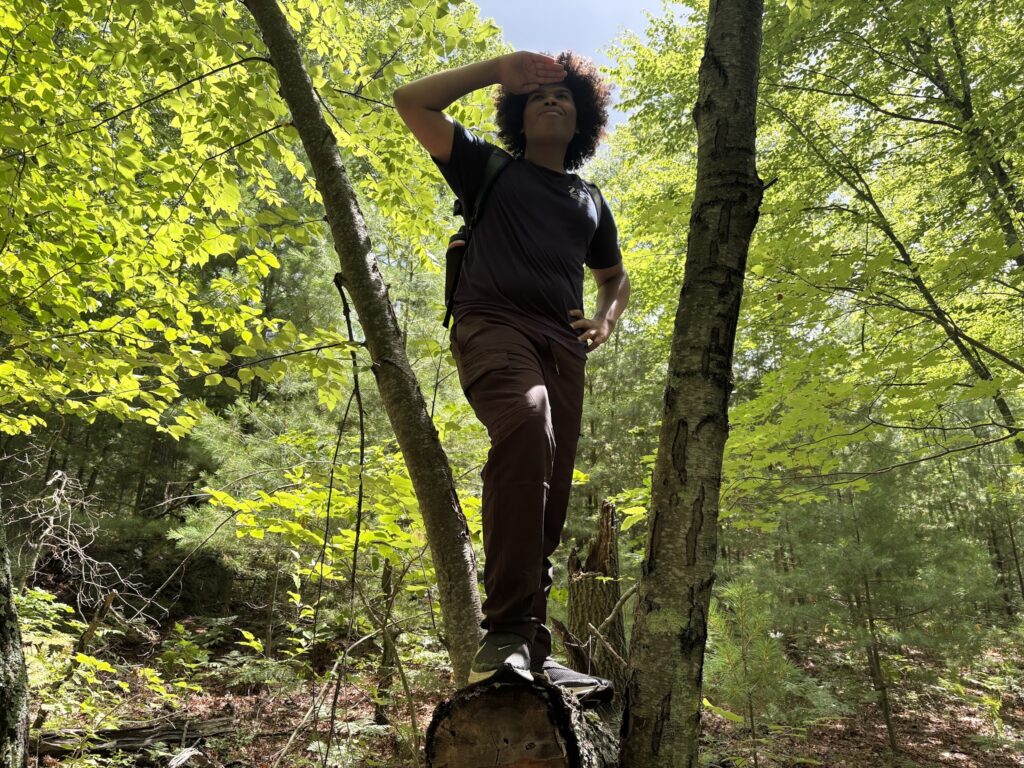
This summer, the Zoo Teens got the chance to visit a variety of sites. Over the course of four weeks, the teens learned valuable skills in radio telemetry, wildlife identification, and so much more. Here is what they have to say about their experience:
Atticus – Radio tracking
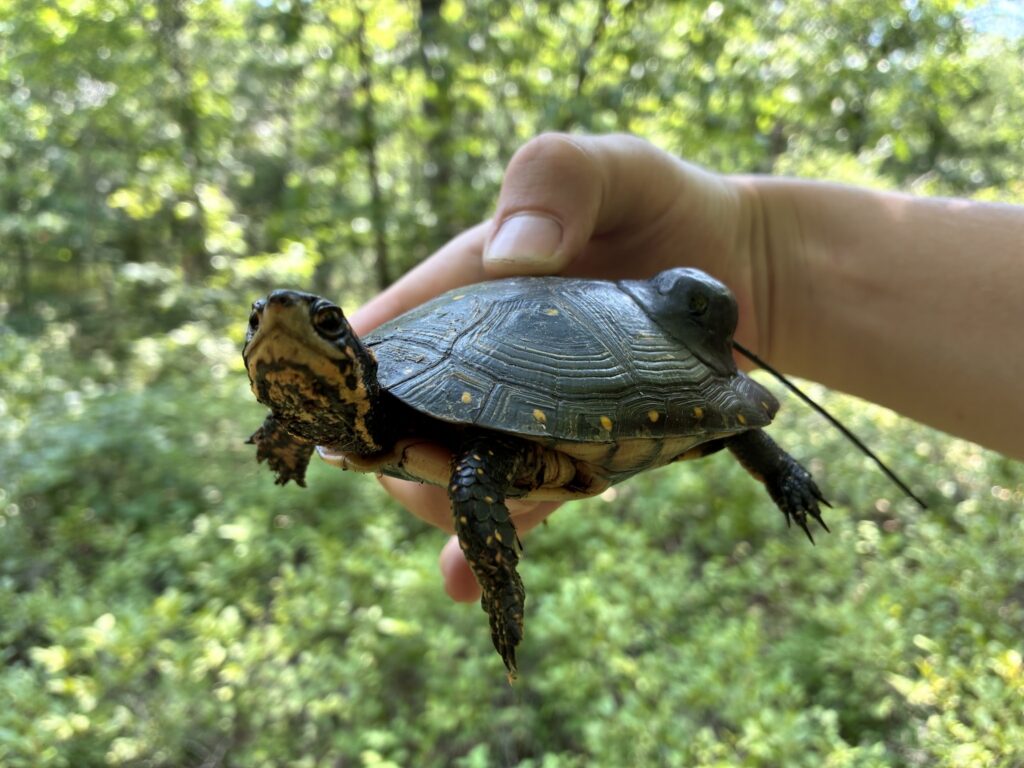
We’ve finished up our work for the summer season at the Stony Brook Reservation in Hyde Park, Boston. The highlight of the experience was, for me, learning to radio track and using the skill to find lots of amazing turtles. Radio tracking is a technique used to locate tagged animals. The handheld radio is tuned to an individual-specific frequency which is emitted by a small antenna on the animal. The radios are carefully selected to be no more than 5% of the animal’s weight.
One then locates the turtle by listening for the loudest “ping” and following the signal. The turtles we track in Stony Brook are all adult females. We do this so that we can check up on them and, if they become gravid (the reptile equivalent of pregnant), protect their nests from humans and predators. This then feeds into our HATCH program which you can read plenty about on the blog.
I hope that you’ve learned a little bit about radio tracking and its uses. Thank you for reading and stay curious!
Giovanni – Life Beyond Turtles
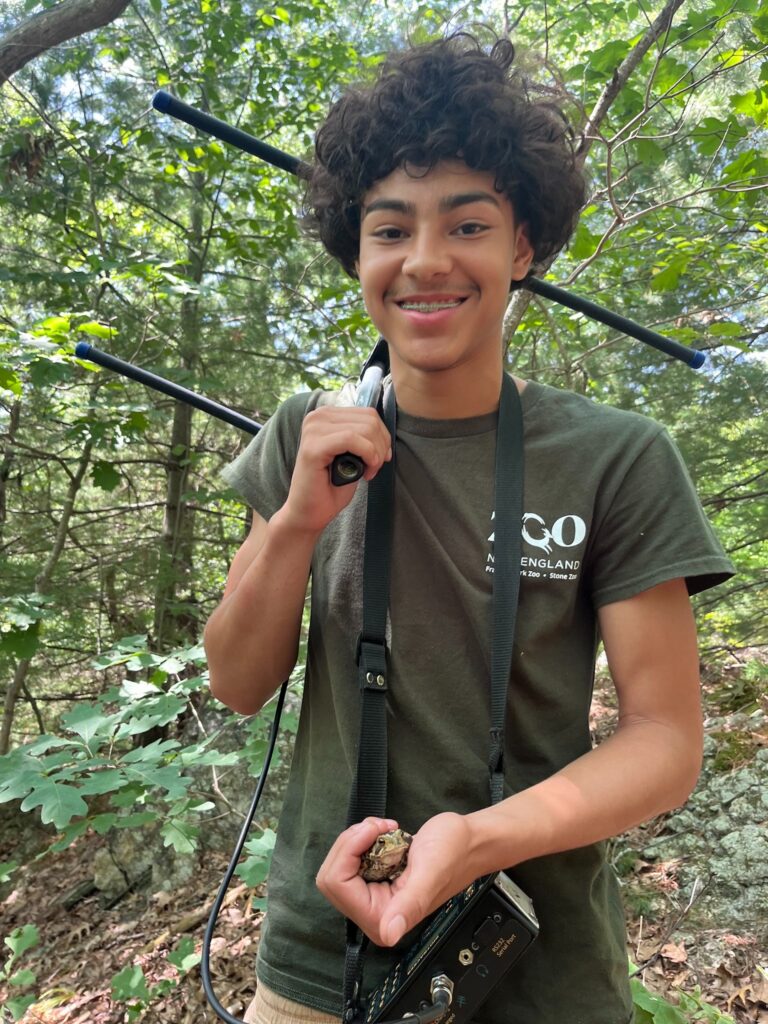
While working with turtles we often come across many other species, such as American toads, differing fish species, snails, Eastern Cottontails, Eastern Grey Squirrels, and several species of mice. This made me wonder how the diverse population of animals in Stony Brook play a pivotal role in the ecosystem. Surprisingly enough turtles and the species I’ve mentioned show strong signs of a healthy ecosystem, which means life in Stony Brook is very balanced. From what I’ve witnessed many animals find Stony Brook as their home and we as conservationists should continue protecting and reserving this habitat. Furthermore, keeping this park clean allows us to experience the cool wildlife at Stony Brook and keeps the animals’ habitats preserved.
The next time you’re out in Stony Brook, explore and observe the amazing wildlife the park has to offer!
Isaac – The Importance of Stony Brook Reservation as a Wildlife Refuge
Stony Brook is a 616 acres wildlife refuge located in Hyde Park Boston. It is a dense forest with ponds, streams and vernal pools spread throughout the reservation. Stony Brook is the largest forested open space in the city of Boston. Established in 1894, it has served as a safe haven for so many kinds of life. Stony Brook is home to 146 different species of animals, some of which are rare. For example the Spotted Turtles that we work with. Spotted turtles like to live in vernal pools, very shallow bodies of water that dry up depending on the season. These vernal pools can be very hard to come by in a city, but Stony Brook is filled to the brim with them, making it one of the only places in the city where you can find Spotted Turtles. It’s not just turtles that rely on vernal pools either, amphibians like frogs, toads, and salamanders use it to lay their eggs as it is a body of water where predators like fish can’t reach them. The site is also the home of hundreds of species of plants and fungus that rely on specific substrates to grow. The reservation is essential to the survival of hundreds of thousands of living organisms. It is also an amazing place for people to relax and explore.
I visit Stony Brook quite often and I have to say it’s an amazing place to go and see all kinds of wildlife. Thankfully Stony Brook is designated as a “Zone 1” (the most restrictive category) in the DCR’s land stewardship zoning categories. The designation was made because it contains rare wetland wildlife, species under the endangered species program and was identified as Massachusetts natural heritage. If someone came along and built ten apartment complexes in Stony Brook, we would see a massive loss of wildlife in the site but also in Boston. Unfortunately, despite these laws a lot of littering and poor upkeep has occurred in certain parts of the reservation. What we can do as people is make sure to speak up about the importance of these areas to get others to care, reach out to our local lawmakers and DCR to encourage better upkeep, and make sure we leave no trace when visiting the park. If we are able to do this, Stony Brook Reservation will continue to be a bustling hub of wildlife and an amazing spot for recreation for many years to come.