
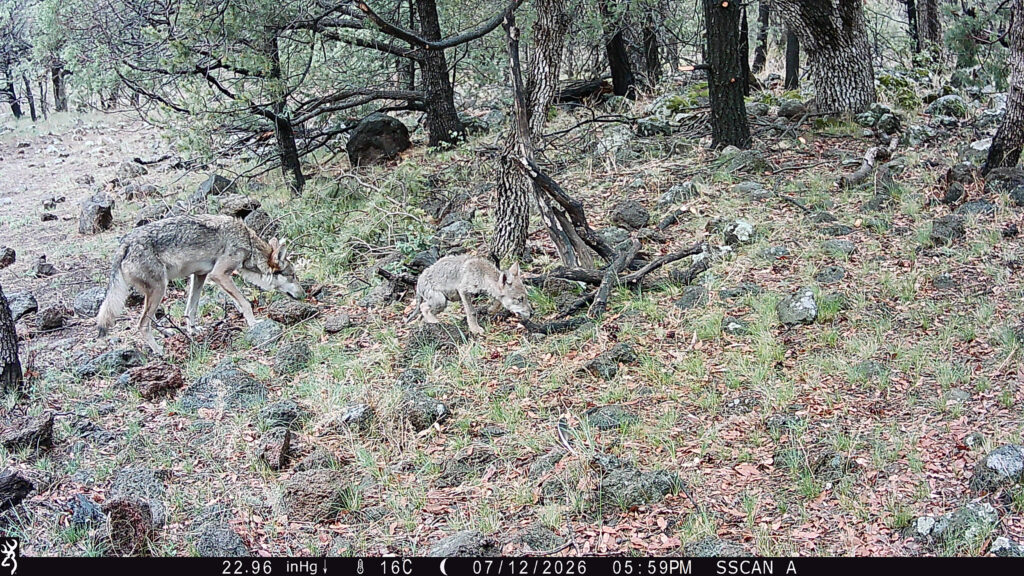
Zoo New England (ZNE) partners with Fundación Tonkawa to support the monitoring and recovery of Mexican gray wolves in northern Mexico. Once common across much of northern Mexico, there are now only thought to be 15-20 wolves left in the country. Earlier this summer, an exciting discovery was made: a Mexican wolf pup was captured on a remote camera! The pup was spotted traveling with the Rancho El Terraceño pack and is the first wild-born pup seen in Mexico since the start of Tonkawa’s monitoring effort. With so few wolves living in Mexico, every pup is crucial.
Once common throughout the American southwest and Mexico, Mexican wolves are now the rarest subspecies of the gray wolf in North America, with 317 individuals living in the United States. The US and Mexico participate in a collaborative recovery plan, including a bi-national captive breeding program. As part of this program, Zoo New England houses and cares for five Mexican wolves at Stone Zoo in Stoneham, MA.
In 2023, the SAFE (Saving Animals From Extinction) Mexican Wolf Program was established, a cross-border program that unites Mexican wolf conservationists and stakeholders from all sectors. SAFE Mexican Wolf aims to connect the latest science with coexistence measures that will help wolves and the people that live among them thrive. ZNE is a proud partner of SAFE Mexican Wolf. Read more about SAFE Mexican Wolf
With the support of ZNE and other government and NGO partners such as the Secretariat of Environment and Natural Resources (SEMARNAT), National Commission of Protected Natural Areas (CONANP), US Fish and Wildlife Service (USFWS), Arizona Game and Fish, and Cincinnati Zoo, the team at Tonkawa made major progress so far in 2026. Their monitoring area spans over 7,000 kilometers (4,350 miles) from Chihuahua to Durango. As of August 2026, Tonkawa has identified 14 individual wolves and estimates the total population in Mexico to be between 15-20 individuals.
Wolves are identified through monitoring activities such as remote cameras, scat surveys, tracking, and collaring individual wolves. Since the beginning of 2025, Tonkawa has expanded their monitoring from ten cameras and two field technicians to over 40 cameras, six field technicians, and four collared wolves. This progress is crucial to understanding the movements, range, and behavior of wolves in Mexico, and for designing appropriate conservation actions to help recover the population.
Tonkawa’s approach to conservation is community-led and centers coexistence at the core of its mission. Tonkawa believes that ranchers and landowners living in Mexican wolf territory can not only learn to tolerate wolves but benefit socially and economically from their presence. Their field technicians work in collaboration with local ranchers, involving them directly in wolf monitoring activities and helping to provide information that will support long-term coexistence. Through these partnerships, Tonkawa is expanding the suitable range for Mexican wolves and developing a wildlife corridor while effectively influencing the culture of Mexican ranching communities.