
For two weeks each July, our biologists wader up to survey the ponds of the Arnold Arboretum of Harvard University. For our seventh year in a row of surveying, the Zoo Teens took the lead, adding an additional 7 turtles to the count. The ponds are home to three unique turtle species: Snapping Turtles, Painted Turtles, and Red Eared Sliders. The teens learned to handle, weigh, and measure turtles, as well as how to ID a variety of different species of turtles, amphibians, fish, and invertebrates. Teens from every department got the chance to participate, so here is what the conservation teens have to say about their experience:
Atticus – Snapping turtle
Weeks one and two done! We saw lots of great turtles, amphibians, and invertebrates in the ponds of the Arnold Arboretum, but in this post I’ll be focusing on the snapping turtles. The common snapping turtle, Chelydra serpentina, is a large omnivorous turtle whose range spans most of the North American east coast. Their strong jaws and surprisingly agile necks make snapping turtles fierce predators of nearly anything they can get their mouth around, including the occasional ZooTeen.
We caught our first snapper our second day. Not expecting anything special, we pulled up one of the turtle traps in Rehder pond to be greeted with a behemoth of a turtle covered with algae.
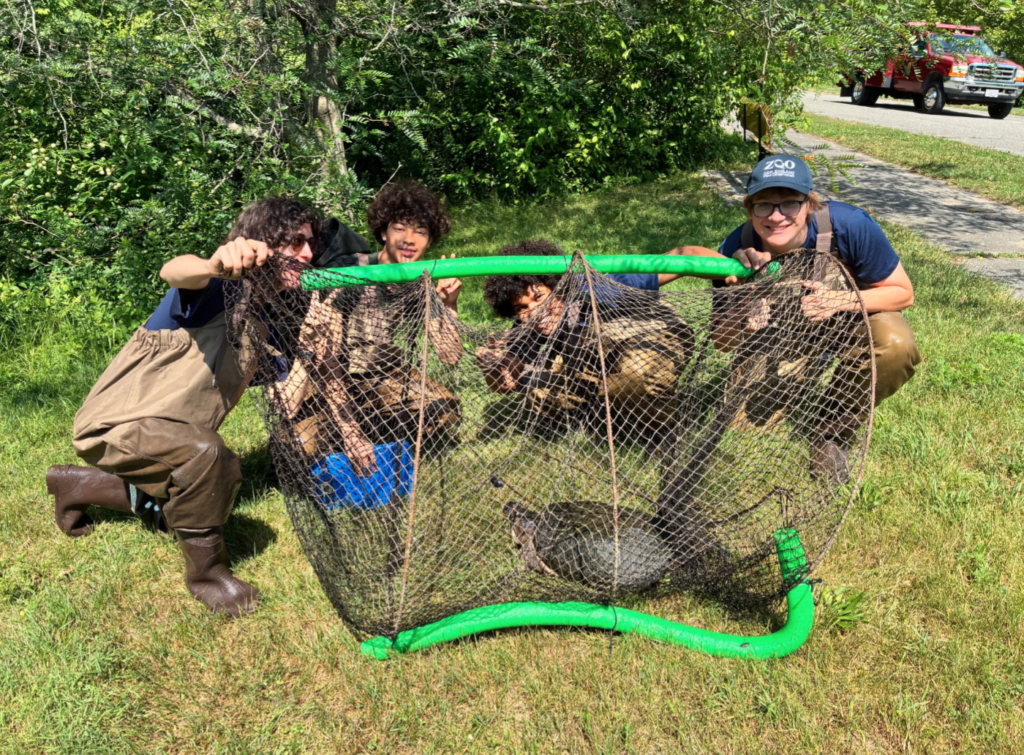
After a demonstration and safety-brief from Matt (Associate Director of Field Conservation) we were itching to lay hands on our newest friend, SNTU 32. We were taught to hold him (we learned to check his sex by his cloaca position) as far back as possible to avoid a mouth that can reach anywhere in the front half of his body. We then took dimensions – carapace (upper shell) and plastron (lower shell) length, max width, and shell depth – and, as a previously unobserved turtle, notched the outer keratin layer of his shell with the identifying number “32”.
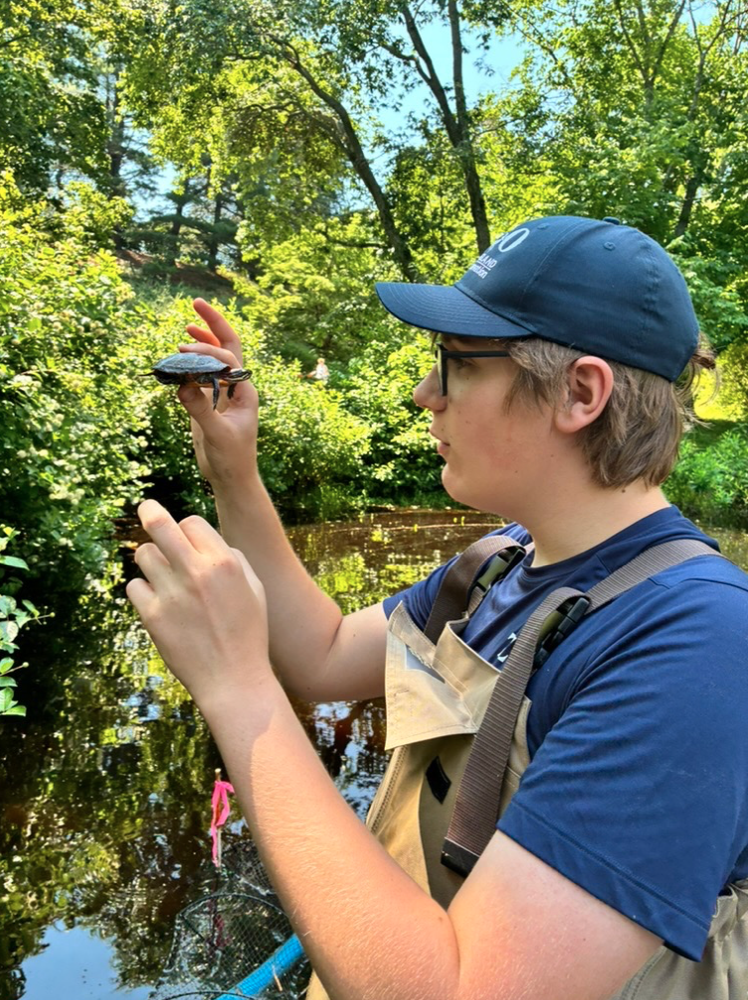
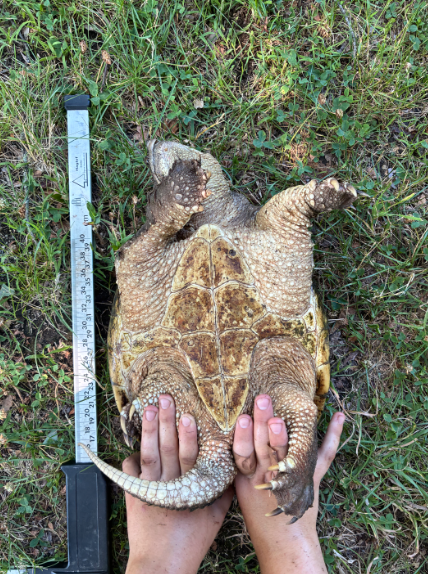
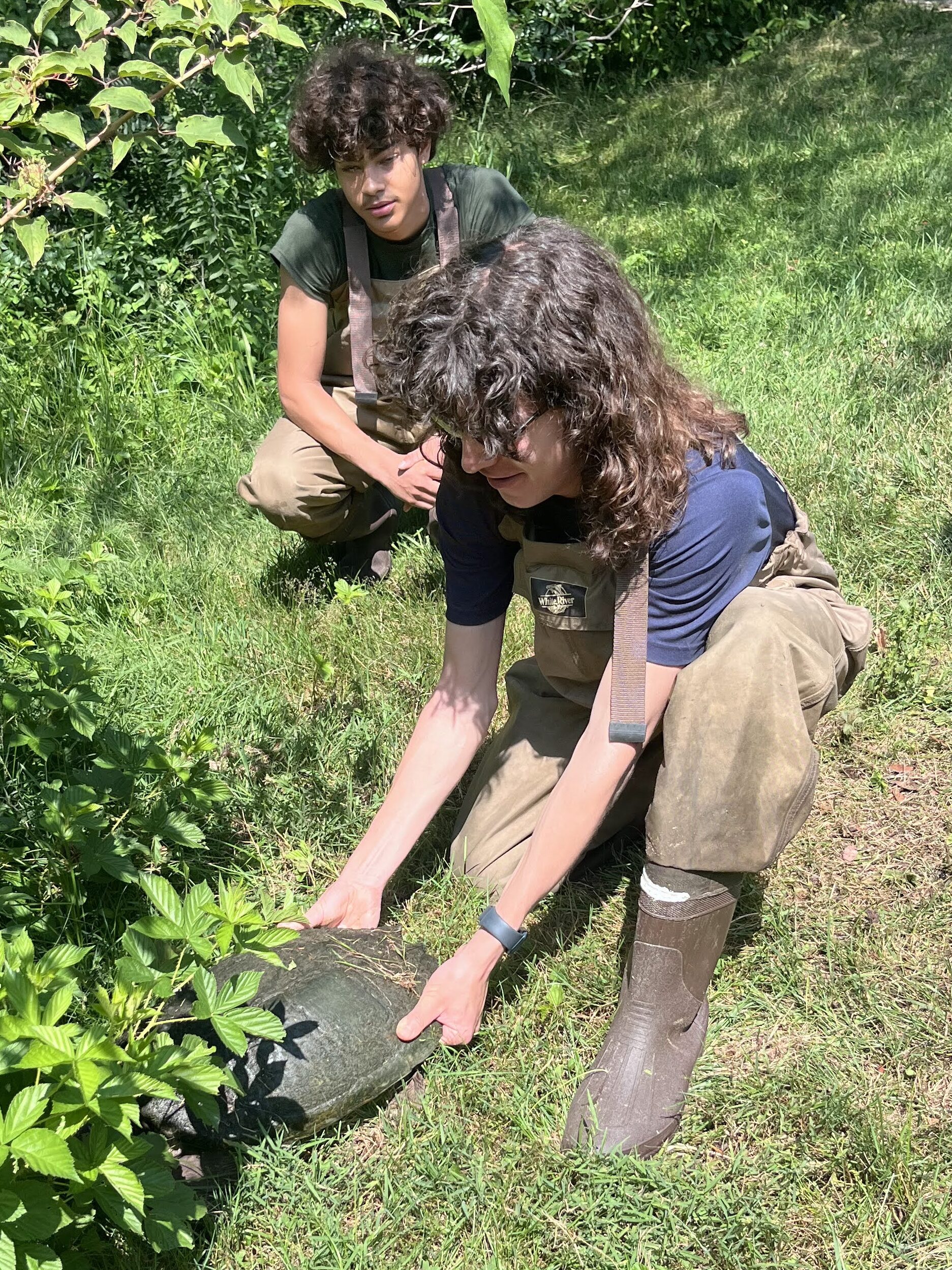
Over the course of our two weeks on site we trapped three previously unmarked snappers including one with a 376 mm (nearly 15 inch) carapace! A special highlight came when we successfully removed a large snapper from a rather small trap which it had entered. It also gave us a great view of the small plastron indicative of snapping turtles, which gives them remarkable flexibility in their legs and neck.
Well, that’s all for now. Thank you for your support of Zoo New England’s conservation work and for allowing us to do this incredible work. Please remember to be a conscious neighbor to our backyard animals, and keep your eyes peeled for snapping turtles!
Until next time,
Atticus
Giovanni – Painted Turtle

Throughout week one and two we were introduced to a lot of interesting species like red eared sliders, and snapping turtles. However, one in particular caught my eye: painted turtles. On our first day we caught our first painted turtle number 44. We later caught him the next day in the same spot! We notch turtle shells as a means of identification. For example if we catch a new turtle without a notch then it would be a new addition to our record of the Arnold’s Arboretum turtle population. This way we can steadily track whether the population has increased through our data base. This gives us estimated numbers on the amount of painted turtles in the ponds. Painted turtles are very unique looking as they have painted yellow and red stripes on the throat and arms with orangey splotches across the underside of their carapace. These turtles can get as big as your hand, and are very friendly! Ultimately, these two weeks at Arnold Arboretum have taught me and my peers about working with turtles in the field.
Ren – Red-Eared Slider
What a start to the summer! Triple digit heat, wildfire haze, and most importantly, plenty of turtles! I’ll be talking about red-eared sliders (Trachemys scripta elegans), which are medium sized semi-aquatic turtles named for the signature red stripe behind their ear. These were the only turtle I hoped to see as little of as possible! Not because they aren’t cool turtles, but because they are an invasive species in Massachusetts. Red eared sliders’ natural habitat spans from the central U.S. and extreme northern Mexico, being native species from West Virginia in the east to New Mexico in the west, and Illinois in the north to the Mexican states of Tamaulipas and Nuevo León in the south. However, they’re found across the world as invasive species in far too many places to count; here is an iNaturalist map of all the world’s red-eared slider sightings. They’re so widespread because they are highly popular in the global pet trade, and often grow much larger (regularly reaching 6 pounds) and live much longer (occasionally over 70 years) than many people who buy them on impulse are prepared for, so they’re often irresponsibly released into the wild. I was only present to see 1 red-eared slider at the Arboretum this year, but we’ve tracked about a dozen of them in the Arboretum’s ponds over the years.
Though our scientists only survey the ponds for 2 weeks each year, it is still important to remember that humans and wildlife coexist all year long. These surveys allow us to better understand how these interactions may occur, and can be a very valuable teaching experience as well! With hundreds of people walking through the Arboretum every day, many people got to speak with our scientists, and the Zoo Teens also did an excellent job at relaying this information to the public. We hope to continue this partnership for years to come, and are excited to learn more!

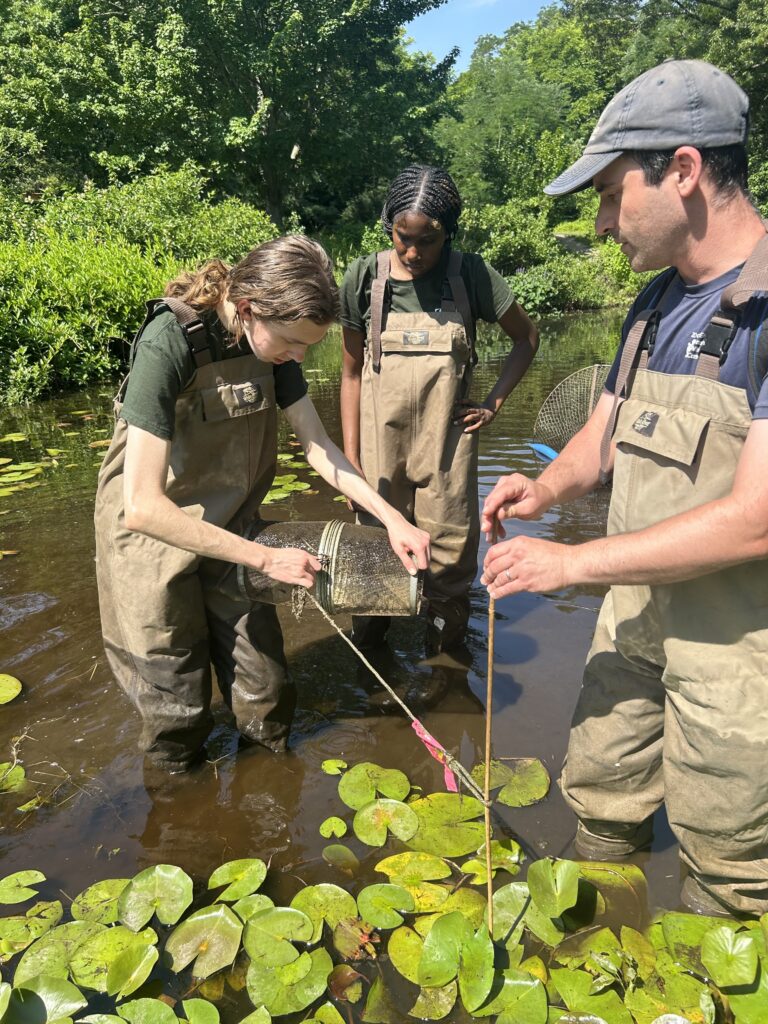

Teens from Education, Children’s Zoo, Commissary, and Horticulture participating as well!